
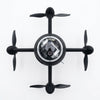
High-Velocity Neutralization: The Technical Architecture of Modern Interceptor Drones
, بواسطة PID Master, 3 دقيقة قراءة
, بواسطة PID Master, 3 دقيقة قراءة
As unmanned aerial threats evolve from simple remote-controlled hobbyist craft into sophisticated, frequency-hopping, and autonomous loitering munitions, traditional "soft-kill" electronic countermeasures often reach their limits. The emergence of the Kinetic Interceptor Drone—such as the RapidDart X-4T—represents a critical shift in Counter-UAS (C-UAS) strategy: moving from signal interference to high-speed physical interception.
Below is a technical deep dive into the engineering principles that allow these platforms to dominate the low-altitude airspace.
The core requirement of an interceptor is a massive thrust-to-weight ratio. To neutralize a moving target, the interceptor must not only be faster than the intruder but must also possess the "sprint" capability to close the gap before the target reaches its objective.
High-KV Power Loops: Interceptors utilize specialized high-KV brushless motors paired with high-voltage LiPo battery systems. This configuration allows for rapid RPM shifts, enabling the drone to accelerate from a hover to speeds exceeding 160 km/h in a matter of seconds.
Aero-Structural Stiffness: At extreme velocities, airframe vibration (harmonics) can interfere with the Inertial Measurement Unit (IMU). The use of high-modulus carbon fiber frames—often with 6mm thick arms—provides the torsional rigidity required to maintain flight stability during high-G maneuvers.
In a high-speed interception mission, situational awareness is a millisecond-by-millisecond requirement.
1080P Digital Link: While consumer drones focus on 4K resolution for cinematography, tactical interceptors prioritize low-latency throughput. Utilizing a high-definition 1080P digital transmission system ensures the operator (or an AI tracking system) has a crystal-clear view for target verification without the lag associated with heavy video processing.
Optical Tracking Integration: Modern interceptors are designed to interface with ground-based detection systems. Through protocols like MAVLink, the drone can be "slaved" to radar or RF-finding sensors, automatically slewing the camera toward the detected threat upon takeoff.
One of the most significant technical hurdles for C-UAS platforms is operating in "noisy" electromagnetic environments, especially if friendly jammers are active nearby.
Frequency Agility: Interceptor command links are engineered to operate across expanded frequency bands with rapid hopping capabilities, ensuring that the drone remains controllable even when local electronic warfare systems are suppressing the 2.4GHz or 5.8GHz spectrums.
Kinetic vs. Electronic: Unlike jamming, which can be defeated by pre-programmed GPS-independent flight paths, a kinetic interceptor is "frequency-blind" at the point of impact. Its effectiveness is based on physics, not signal manipulation, making it the ultimate fail-safe against autonomous "dark" drones.
The flight controller (FC) of an interceptor drone must be tuned differently than a standard industrial UAV.
Dynamic PID Scaling: The "Proportional-Integral-Derivative" (PID) loops are optimized for aggressive response. This allows the drone to remain rock-steady during a full-throttle dash while still being precise enough to perform a surgical strike on a small FPV target.
Intervention Payloads: Beyond mere collision, these platforms can be equipped with various neutralization mechanisms, such as net-launchers or specialized airframes designed to disable the propellers of an adversary drone upon contact.
The engineering of an interceptor drone like the RapidDart X-4T is a balance of raw power, structural resilience, and low-latency communication. As the "cat and mouse" game of drone technology continues, the ability to physically interdict a threat remains the most reliable method for protecting critical infrastructure and personnel.
Technical Specifications & Deployment: For organizations looking to integrate high-speed kinetic solutions into their security architecture, the RapidDart series offers a scalable, high-performance platform designed for the most demanding environments.
Explore the full technical data sheets at cktdrone.com.